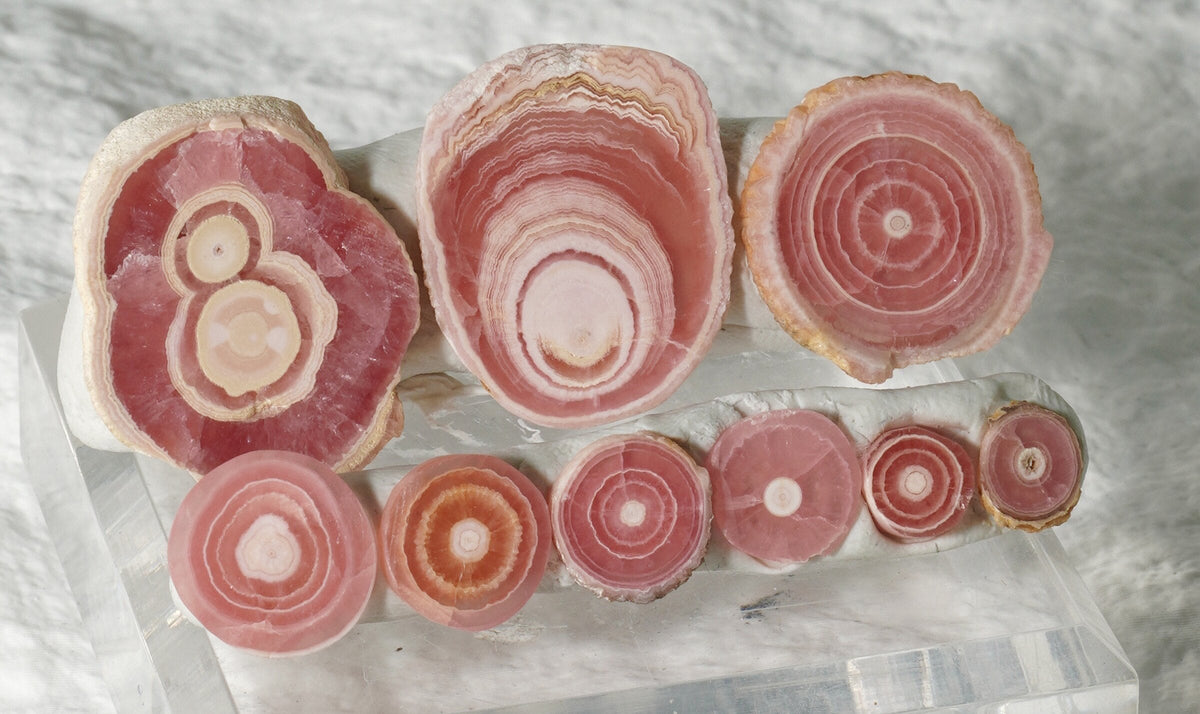
A rhodochrosite stalactite slice is a polished cross-section cut from a stalactite of rhodochrosite, a manganese carbonate mineral (MnCO₃). Cutting across the stalactite's growth axis exposes concentric pink and white rings, often called a rose or bull's-eye pattern. The finest stalactitic material comes from Argentina, where rhodochrosite is the national gemstone.
What is rhodochrosite?
Rhodochrosite is a manganese carbonate mineral. Manganese gives it a pink to red color. Its name comes from Greek words meaning "rose" and "coloring." Lighter pinks occur where calcium, and to a lesser degree magnesium, iron or zinc, replace some of the manganese.
| Property | Value |
|---|---|
| Chemical formula | MnCO₃ (manganese carbonate) |
| Crystal system | Trigonal |
| Mohs hardness | 3.5–4 |
| Specific gravity | about 3.5–3.7 |
| Cleavage | Perfect, rhombohedral, in three directions |
| Luster | Vitreous to pearly |
| Streak | White |
| Other names | Inca Rose, Rosa del Inca |
How do rhodochrosite stalactites form?
Rhodochrosite stalactites form when mineral-rich water deposits manganese carbonate inside open cavities, layer by layer. In hydrothermal ore deposits, warm fluids carrying dissolved manganese move through fractures in the rock. Where they drip into a cavity, rhodochrosite builds up around a central axis, the same way calcite stalactites grow in limestone caves.
Each layer records the fluid chemistry at the time it was deposited. When the manganese content was higher, the layer is a deeper pink. When it was lower, or when calcite was deposited instead, the layer is paler or white.
Why does a slice show rings?
A slice shows rings because it cuts across the stalactite's layers, like cutting across a tree trunk. The center of the slice is the oldest part of the stalactite, and the outer rings are the youngest. Several patterns are common:
- Bull's-eye: one center surrounded by even, nested rings.
- Rose: rings with wavy, petal-like edges.
- Multiple eyes: two or more centers in one slice, where neighboring stalactites grew together.
- Matrix rim: an outer edge of host rock still attached to the rhodochrosite.


No two slices are the same, even when they are cut from the same stalactite. Neighboring slices from one piece share a similar pattern but differ in ring width and color.

Where do rhodochrosite stalactites come from?
Most rhodochrosite stalactites on the market come from Argentina. The classic source is the Capillitas mining district in Catamarca Province, in the northwest of the country. Capillitas has been worked since at least the mid-1800s, mainly for copper and silver. Rhodochrosite was first a by-product of that mining before collectors and lapidaries began to value it.
Argentina named rhodochrosite its national gemstone. The trade name "Inca Rose" (Rosa del Inca) refers to this Argentine material.
Is a polished slice still a natural specimen?
Yes. Polishing only smooths and brightens the cut surface. The rings, colors and inclusions are natural. Natural slices commonly show small pits, fine fractures, uneven ring widths and areas of white calcite. These are part of how the stalactite grew, not defects added in cutting.

Imitations exist. Some are made from crushed rhodochrosite bound with resin. They feel noticeably lighter in the hand, with a specific gravity of about 2 compared with about 3.5–3.7 for natural rhodochrosite.
How to care for a rhodochrosite slice
Rhodochrosite is soft and reacts with acids, so it needs gentle care. General guidance for all specimens is on our Mineral Care page.
- Dust it with a soft, dry brush or cloth.
- Keep it away from acids, including vinegar, lemon juice and many household cleaners. Rhodochrosite fizzes slightly in acid, which can dull the polish.
- Do not use ultrasonic or steam cleaners.
- A short rinse in plain water is fine; dry it right away.
- Store it apart from harder stones such as quartz, which can scratch it.
- Display it on a stand or a padded surface. With perfect cleavage, a slice can chip if it is dropped.

Notes from handling rhodochrosite slices
These notes come from AURENTHE's own work photographing, fitting and shipping Argentine rhodochrosite slices.
Size. Slices differ so much in size, even within one lot, that a typical range would be misleading. We measure any individual slice on request.
Stands. Each slice we offer is fitted with its own display stand, made to match the slice's size and shape.
Packing. We wrap each slice in three layers: soft tissue paper against the polished faces, then EPE foam, then bubble wrap. We then fill the box so the slice cannot shift, which cushions it against knocks in transit.
How to read a slice before choosing one
To compare slices, look at four things: the number of centers, how sharp the rings are, the color range from pink to deep red, and whether any matrix is present. Photos taken under different lighting can show the color differently, so check more than one photo when possible.
Size matters for display. If the dimensions of a specific slice are not listed, a seller can usually measure it on request.
AURENTHE photographs each slice individually and gives it its own specimen number. Individual slices are listed on the Rhodochrosite Slice page.
Frequently asked questions
Is rhodochrosite natural or dyed?
The pink color of rhodochrosite is natural and comes from manganese. Stalactite slices are cut and polished, but their rings and colors are not dyed.
How long does a rhodochrosite stalactite take to form?
A stalactite builds up one thin layer at a time over a long geological period. The exact time is not known for any individual piece, and the growth rate varied with the fluids that deposited it.
Can rhodochrosite get wet?
A brief rinse in plain water will not harm a polished slice. Avoid soaking it, and avoid acids, salt water and household cleaners, which can dull the surface.
Why is rhodochrosite called Inca Rose?
"Inca Rose" (Rosa del Inca) is a trade name for Argentine rhodochrosite. It refers to the stone's rose color and its source in the Andes of northwestern Argentina.
What is the difference between a rhodochrosite slice and a cabochon?
A slice is a flat cross-section that shows the full ring pattern on both faces. A cabochon is cut from a slab and shaped into a domed stone for jewelry.
How hard is rhodochrosite?
Rhodochrosite is 3.5 to 4 on the Mohs scale, softer than quartz (7) and similar to fluorite (4). It is better suited to display than to everyday-wear jewelry such as rings.
How are rhodochrosite slices packed for shipping?
AURENTHE wraps each slice in soft tissue paper, then EPE foam, then bubble wrap, and fills the box so the slice cannot move during transit.