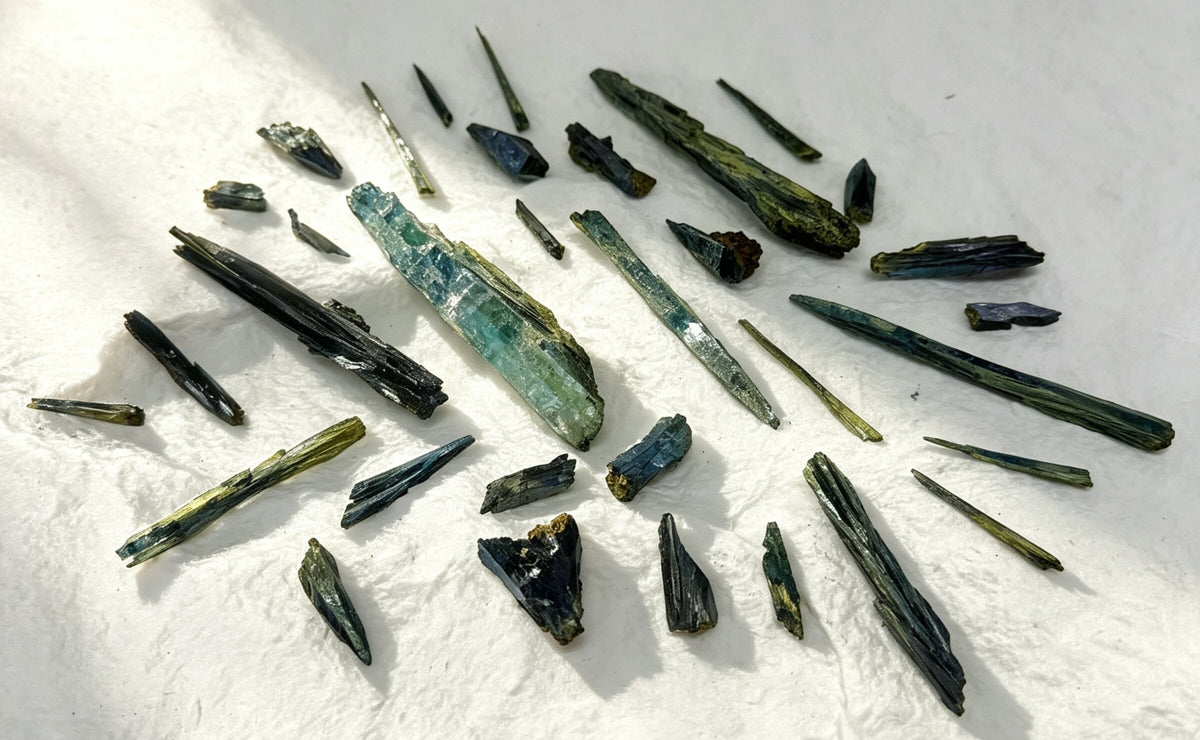
Vivianite is a hydrated iron phosphate mineral that forms blue-green, blade-shaped crystals. Fresh vivianite is nearly colorless to pale green. Light slowly oxidizes the iron inside the crystal, so the color deepens to blue, dark green and eventually near black. This color change is the mineral's best-known trait, and it decides how a specimen should be stored and displayed.
What is vivianite?
Vivianite is an iron phosphate with water built into its crystal structure. It is one of the softest minerals collected for display. Thin crystals can even bend slightly before they break.
| Property | Value |
|---|---|
| Chemical formula | Fe₃(PO₄)₂·8H₂O (hydrated iron phosphate) |
| Crystal system | Monoclinic |
| Mohs hardness | 1.5–2 |
| Specific gravity | about 2.7 |
| Cleavage | Perfect in one direction |
| Tenacity | Flexible in thin blades; sectile |
| Luster | Vitreous; pearly on cleavage surfaces |
| Streak | White, turning blue or brown |
| Named after | John Henry Vivian (1785–1855), Cornish mineralogist |

Why does vivianite darken?
Vivianite darkens because light oxidizes its iron. When first formed, the iron in vivianite is ferrous iron (Fe²⁺), which gives little color. Visible light drives a reaction that turns some of it into ferric iron (Fe³⁺). Crystals that hold both forms of iron absorb more light, so they look blue-green and then darker.


The change happens inside the crystal, not only on the surface, and it cannot be reversed. Over a long time, heavily oxidized vivianite can turn into a related mineral called metavivianite and lose its transparency.
How vivianite forms
Vivianite forms where iron, phosphate and water meet in low-oxygen conditions. It occurs in four main settings:
- Ore veins: in the altered upper zones of metal ore deposits. Hydrothermal veins produce the best-formed transparent crystals.
- Pegmatites: in granite pegmatites that contain phosphate minerals.
- Sediments and bogs: in clays, peat and lake sediments, where it can replace plant material.
- Fossils: inside fossil shells, or replacing bones and teeth buried in peat.
Where does vivianite come from?
Well-known localities include Bolivia, Brazil and Cameroon.
- Bolivia: the tin mines of Llallagua and Huanuni have produced transparent green crystals up to about 10 cm.
- Brazil: most Brazilian vivianite on the market today comes from the Amazon region, including claims along the Cauaburi River near São Gabriel da Cachoeira. Older finds came from phosphate pegmatites around Galiléia, Minas Gerais, which produced wedge-shaped crystals up to about 11 cm.
- Cameroon: crystals more than a meter long have been found in mud deposits.
How to store and display vivianite
Vivianite is soft and light-sensitive, so the aim is to slow its darkening and avoid damage. General guidance for all specimens is on our Mineral Care page.
- Keep it out of direct sunlight and away from strong lamps.
- Store it in a closed box or drawer when it is not on display.
- For display, choose a shaded shelf or cabinet with low, indirect light. LED light gives off less heat than older bulbs, but any light still causes slow darkening.
- Handle it by the matrix, not the crystals. The blades scratch and split easily.
- Do not wash it. Remove dust with a soft brush or a gentle puff of air.
- Keep it away from acids and humid places.
With careful storage, the color changes very slowly. Some darkening over the years is expected and is part of the mineral's natural character.
Notes from handling vivianite
These notes come from AURENTHE's own work measuring, photographing and shipping vivianite from the Brazilian Amazon.
Size, for new collectors. Among 19 vivianite specimens from the Brazilian Amazon that we have measured, the longest dimension ranged from about 4.7 to 18 cm, and weight from about 13 to 139 g. If you are buying your first piece, we suggest a compact specimen, around 5 to 8 cm, with its blades firmly attached to matrix. It is easier to handle and display, and less likely to break than a long single blade.
Light. In our experience, frequent exposure to strong light speeds up the loss of vivianite's fresh blue-green color.
Packing. We wrap each specimen in three layers: soft tissue paper against the crystals, then EPE foam, then bubble wrap. We then fill the box so the specimen cannot shift, which cushions it against knocks in transit.
How to read a vivianite specimen
When comparing specimens, look at crystal color, transparency, how the blades are arranged, and how much matrix supports them. Undamaged crystal tips and a stable base matter more than size alone. Color in photos depends on lighting, so compare several photos of the same piece.

AURENTHE photographs each vivianite specimen individually and lists its measurements. Available pieces are on the Vivianite page.
Frequently asked questions
Why does vivianite turn black?
Light oxidizes the ferrous iron (Fe²⁺) in vivianite to ferric iron (Fe³⁺). As more iron oxidizes, the crystal moves from pale green to blue-green, dark green and finally near black. The change is permanent.
How should I store vivianite?
Keep it in the dark when it is not on display, such as in a closed box or drawer. On display, use a shaded spot with low, indirect light, away from windows and strong lamps.
Can vivianite get wet?
Avoid it. Vivianite is very soft and dissolves in acids. Water and cleaning can damage the crystal surfaces, so dust it with a soft brush instead.
How hard is vivianite?
Vivianite is 1.5 to 2 on the Mohs scale, about as soft as gypsum. A fingernail can scratch it, so it is a display mineral, not a jewelry stone.
Is vivianite rare?
Vivianite is found in many places, but well-formed, transparent crystals are uncommon. Specimens from classic localities in Bolivia, Brazil and Cameroon are the most collected.
Who is vivianite named after?
It is named after John Henry Vivian (1785–1855), a Cornish mineralogist and mine owner. The name was published in 1817.
How is vivianite packed for shipping?
AURENTHE wraps each specimen in soft tissue paper, then EPE foam, then bubble wrap, and fills the box so the specimen cannot move during transit.
References
- Anthony, J. W. et al. Vivianite. Handbook of Mineralogy, Mineralogical Society of America.
- Vivianite. Wikipedia.
- Vivianite. International Gem Society.
- Cassedanne, J. P. and Cassedanne, J. O. (1982). Présence de legrandite dans une pegmatite de Minas Gerais, Brésil. The Canadian Mineralogist, 20, 87–89.
- Vivianite, Cabeça do Cachorro claim, São Gabriel da Cachoeira, Amazonas, Brazil. FossilEra specimen listing.